





The Sunday Magazine23:42Canada opened its arms to Syrians 10 years ago. Now, our refugee system is in flux
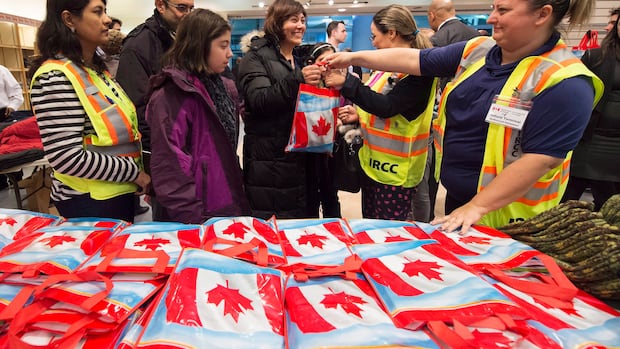
Ten years ago, Canada responded to the unfolding humanitarian crisis in Syria with an unprecedented program that rapidly resettled 25,000 Syrian refugees in roughly 100 days.
To meet that target, the federal government accelerated every step of the process — from identifying refugees, processing visas, co-ordinating transportation and supporting their arrival and integration across the country.
“It was surreal to live through,” said Chris Friesen, CEO of the Immigrant Services Society of British Columbia, which was at the forefront in settling families in that province.
Friesen recalls holding a news conference appealing to the public for help — housing options, job leads and volunteers who could step in to welcome the families about to arrive.
“The responses crashed our systems, it was just unbelievable,” Friesen told The Sunday Magazine.
But a decade after Canada fast-tracked Syrians to safety, settlement workers and advocates say the system facing current refugees is far slower and constrained.
“It’s like night and day,” said Friesen. “We’re in a very, very different climate right now.”
 Former refugee Amal Kago, right, poses with the woman she recently helped emigrate from Sudan. Kago says the process was 'not easy' compared to when she came to Canada in 2003. (Submitted by Amal Kago)
Christina Clark-Kazak, professor of public and international affairs at the University of Ottawa agrees, and says Canada is “in a very different time now.”
After an election that returned the Liberals to power with only a fragile minority, Clark-Kazak says the government is acutely aware that it must respond to domestic pressures — particularly from Conservative-leaning voters who are far less supportive of accepting refugees.
She says — as Canadians face rising living costs, ongoing challenges in finding affordable housing, and increasing pressure on public services — refugees and newcomers have too often been unfairly cast as scapegoats for deeper systemic issues.
“We often focus on the demand side … and we don’t look enough at the supply side,” said Clark-Kazak. “People who are coming to this country are also trained as doctors, engineers and construction workers who could build housing."
WATCH | Long wait for Palestinian family:Najlaa Alzaanin is asking the federal government to speed up its special measures visa program for people trying to leave Gaza. Gareth Hampshire has the story.Today's process 'not easy'Data from the Immigration and Refugee Board of Canada shows that there were 9,999 pending refugee claims at the end of 2015. However, as of Sept. 30, 2025, that number has climbed to 295,819.
Amal Kago came to Canada from Sudan as a government-assisted refugee in 2003, one of millions who have been displaced by its long-running civil war.
She recalls the process as being “better” then, and that “it did not take [her] long to come to Canada.”
But when Kago later helped co-sponsor a vulnerable woman from Sudan, the experience was far different.
The process was “not easy,” she said, and stretched to five years before the woman finally reached Canada in 2024.
Rasha Youssef arrived in B.C. from Syria in December 2014. She was sponsored by a group of five people who were with her “all the time” to help her get settled.
Inspired to give back, she worked for a program for women that was a lifeline where newcomers could share their struggles, celebrate together and find joy through conversation.
 Rasha Youssef, left, came to Canada in December 2014 and now owns a small business. Hamoudi Saleh Baratta arrived in 2014 and is now a computer scientist. (Submitted by Rasha Youssef; Submitted by Hamoudi Saleh Baratta)
Likewise, Hamoudi Saleh Baratta arrived in Canada in 2014 after surviving imprisonment and torture under Syria's Assad regime.
He says Canada’s refugee policy at the time was “life-saving” for him.
But both are unhappy with Canada's refugee approach now.
The changing public mood is also directly affecting Regis Chiwaya’s work overseeing private sponsorship and settlement programs at MOSAIC, a Vancouver-based non-profit that supports refugees and migrants.
Chiwaya, who has worked in the sector for nearly five years, has seen “a significant increase in processing times” by overseas visa offices.
“It doesn’t matter whether it’s coming from an African visa office or somewhere in the Middle East, or Europe,” he said.
WATCH | New legislation worries critics:The Liberal government proposed new border legislation this week. But critics say they worry the law will do more harm than good. The CBC's Pratyush Dayal reports.In 2020, he says, applications took one and a half to two years to process. Now, they often stretch to four years.
For example, under an initiative to sponsor migrants held indefinitely off the coast of Australia, Chiwaya says his team is still waiting for the applications of 60 people submitted in 2019 to be processed.
Immigration, Refugees and Citizenship Canada (IRCC) has attributed the delays to post-COVID backlogs but Chiwaya says he hasn’t seen any improvement.
At the same time, Chiwaya says he has seen “less and less” funding for MOSAIC's programs from both federal and provincial governments.
In January 2024, the government launched a special measures program allowing Canadians to sponsor extended family members in Gaza on temporary visas.
It was initially capped at 1,000 applications and later increased to 5,000, all of which were filled. However, as of July 29, only 880 people have arrived in Canada under the program.
Concerns over policiesIn November 2024, the government announced a pause on two of the three forms of refugee sponsorship.
The change was initially set to lift at the end of 2025, but has been extended until the end of next December.
“The real-world implications are that people can’t get here,” Clark-Kazak said.
In a statement to CBC News, the IRCC said that demand for that program was very high, producing long wait times and uncertainty for sponsors. The extension of its pause aims to help move toward more predictable processing times.
Ottawa is proposing other changes to the process, under the Strong Borders Act, which was introduced in June.
The proposed legislation seeks to amend several laws, including the Immigration and Refugee Protection Act.
Clark-Kazak says the legislation may block vulnerable people from making claims in the first place, would bar those who previously came to Canada without filing a claim, and fails to account for the volatile global situation and the complex, individual circumstances of asylum seekers.
In its statement, the IRCC said the changes will strengthen the integrity and efficiency of Canada’s immigration and asylum systems by enhancing domestic information-sharing, improving how asylum claims are processed, tightening controls on immigration documents and applications, and helping prevent claim surges without harming vulnerable applicants.
Youssef, who came from Syria, now works at a law firm and runs her own small business. But she says she’s noticed a cut of funds from “so many organizations” that support refugees.
She’s concerned that cuts risk increasing isolation and depression among newcomers.
Baratta shares her concerns, and says he's "so unhappy" to see the programs that eased his route into Canada decline.
“I just call for politicians and people in power to not politicize humanitarian causes,” he said.