







Listen to this article
Estimated 5 minutes
The audio version of this article is generated by AI-based technology. Mispronunciations can occur. We are working with our partners to continually review and improve the results.
Toronto has cancelled an automated traffic enforcement pilot intended to help fight congestion in the wake of the provincial government’s ban on speed cameras in Ontario, CBC Toronto has learned.
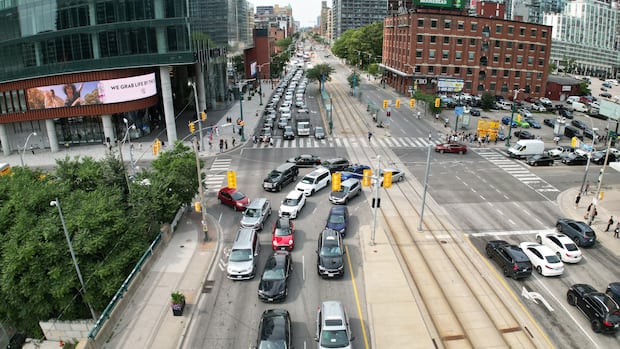
Cameras for the pilot project were supposed to be installed this past summer to gather data on drivers “blocking the box” at intersections, driving in dedicated bus lanes and obstructing bike lanes. Tickets weren’t expected to be issued until sometime next year at the earliest, in part because provincial approval is required to enforce traffic violations this way.
But the cameras were never installed and now the pilot has been axed.
“Recent provincial legislation prohibiting the use of Automated Speed Enforcement cameras indicated that other enforcement tactics would be favoured over automated enforcement tactics,” said city spokesperson Kate Lear.
CBC Toronto dug into how this kind of automated enforcement could help address gridlock in its three-part series, Gridlocked: The Way Out earlier this year. At the time, Seattle was the only North American city issuing tickets for blocking the box and driving in a bus lane through an automated enforcement program — and it appeared to be changing driver behaviour there.
 Matti Siemiatycki, director of the Infrastructure Institute at the University of Toronto, says cancelling the automated enforcement pilot is 'taking out of the toolbox a tool that works.' (University of Toronto)
“This is taking out of the toolbox a tool that works,” said Matti Siemiatycki, director of the Infrastructure Institute at the University of Toronto, of abandoning the automated enforcement pilot.
“So people will continue to experience all the same congestion that they have, all the same traffic and all the same frustration.”
The move comes after Premier Doug Ford’s government passed legislation in late October banning the use of speed cameras in Ontario. It also comes a year after the city approved a congestion management plan that included automated enforcement.
CBC Toronto asked the province if it would ever allow the city to issue tickets through automated enforcement for such traffic violations.
In a statement, the minister of transportation's office said it had not received a proposal from the city and so the province is not exploring any further use of automated enforcement beyond what is already included in the Highway Traffic Act.
Only 9% ‘block the box’ recidivism in SeattleIn January, Toronto’s director of traffic management said the city was hoping to leverage the practices and technology Seattle had in place.
Between the launch of Seattle’s automated enforcement program in 2022 and the end of 2024, only up to nine per cent of vehicle owners who were issued a warning for blocking the box later received a ticket for doing it again.
“The automated enforcement is working... People get an initial ticket and then they learn, and they don't do it again,” said Siemiatycki about the Seattle program.
“To not use one of the tools that’s worked in other regions really puts us behind in an area that we need to be leading.”
The recidivism rate in Seattle was higher for driving in a bus lane, at 45 per cent.
In its statement, the city of Toronto said the first phase of the automated enforcement pilot program gathered valuable information from applicant companies, and the city remains committed to learning how other cutting-edge technology can help address congestion.
 The Toronto Region Board of Trade recommended adopting automated enforcement for traffic violations earlier this year. (Toronto Region Board of Trade)
Toronto’s board of trade also released a congestion action plan in February, which recommended adopting automated enforcement so cameras could catch drivers blocking intersections, double-parking and stopping in bike lanes and at bus stops.
The board’s plan called for legislative amendments to the Highway Traffic Act so the city could move forward with automated enforcement.
"We're disappointed," Giles Gherson, president of the Toronto Region Board of Trade, said Friday.
"This was a fundamental part of [of our action plan]. It's clear that automated enforcement of traffic infractions would be a significant contributor to reducing congestion."
What now?Now it appears the city will have to try and deter drivers the old-fashioned way — with boots on the ground.
Traffic agents at busy intersections prevent vehicles from blocking the box where they can, and police officers issue warnings and fines in person when they're deployed.
Last fall, tickets for blocking the box went up from $90 to $450 at most intersections, and the city budget for this year included $3 million to quadruple the number of traffic agents on its streets to 100.
There were 1,352 tickets issued by Toronto police for blocking the box in 2024, totalling more than $40,000 in fines, according to numbers obtained through a freedom of information request. That’s more tickets for blocking intersections than were issued in the previous five years combined.
Urban planning expert Siemiatycki says if automated enforcement is off the table, then new tools are needed.
“How are we actually going to solve these problems?” he said. “We need another set of solutions and those need to be clear and they should be evidence-based.”