


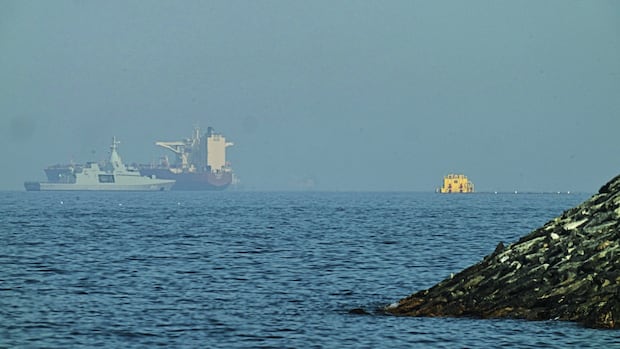







U.S. President Donald Trump says a project will start on Monday to help stranded ships leave the Strait of Hormuz, but he offered few details.
In a social media post, Trump said on Sunday that "neutral and innocent" countries have been affected by the Iran war, and "we have told these Countries that we will guide their Ships safely out of these restricted Waterways, so that they can freely and ably get on with their business."
He said "Project Freedom" would begin Monday morning in the Middle East. Trump added that his representatives are having discussions with Iran that could lead to something "very positive for all."
Iran's effective closure of the strait, imposed after the U.S. and Israel launched the war on Feb. 28, has shaken global markets.
Ships and seafarers, many on oil and gas tankers and cargo ships, have been stuck in the Persian Gulf since the war began.
Crew members have described to The Associated Press watching intercepted drones and missiles explode over the waters, and running low on drinking water, food and other supplies. Many sailors come from India and other countries in south and southeast Asia.
"They are victims of circumstance," Trump wrote, and described the effort as a humanitarian gesture "on behalf of the United States, Middle Eastern Countries but, in particular, the Country of Iran." But he sounded a warning: "If, in any way, this Humanitarian process is interfered with, that interference will, unfortunately, have to be dealt with forcefully."
Trump's statement was quickly shared by some Iranian outlets, which described his announcement as a "claim."
The White House and the Pentagon did not immediately respond to requests for additional information.
Cargo ships reportedly attackedEarlier Sunday, a cargo ship near the Strait of Hormuz said it was attacked by multiple small craft, the British military's United Kingdom Maritime Trade Operations centre reported, while another ship was hit by "unknown projectiles." They were the latest in at least two dozen attacks in and around the strait since the Iran war began, and a reminder of the risks if the new U.S. effort goes forward.
No injuries were reported.
They were the first reported attacks in the area since April 22. Tehran has effectively closed the strait by attacking and threatening ships, and the threat level in the area remains critical.
The first vessel was an unidentified cargo ship traveling north near Sirik, Iran, east of the strait, the British monitor said. Iranian officials have asserted that they control the strait and that ships not affiliated with the United States or Israel can pass if they pay a toll, challenging the freedom of navigation guaranteed by international law.
Iran denied an attack, the semiofficial Iranian outlets Fars and Tabnak reported, and said a passing ship had been stopped for a documents check as part of monitoring.
Iranian patrol boats, some powered only by twin outboard motors, are small, nimble and hard to detect. Trump last month ordered the U.S. military to "shoot and kill" small Iranian boats that deploy mines in the strait.
The second ship was a tanker that reported being struck around 11:40 p.m. local time Sunday while off Fujairah, United Arab Emirates.
Iran makes new proposal to U.S. seeking to end warA fragile three-week ceasefire appears to be holding, though Trump on Saturday told journalists that further strikes remained a possibility.
Iran's latest proposal to the U.S. wants issues between them to be resolved within 30 days and aims to end the war rather than extend the ceasefire, according to Iran's state-linked media.
Trump on Saturday said he was reviewing the proposal but expressed doubt it would lead to a deal, saying on social media that "they have not yet paid a big enough price for what they have done to Humanity, and the World, over the last 47 years" since the Islamic Revolution there.
Iran's 14-point proposal also calls for the U.S. lifting sanctions on Iran, ending the U.S. naval blockade of Iranian ports, withdrawing forces from the region and ceasing all hostilities, including Israel's operations in Lebanon, according to the semi-official Nour News and Tasnim agencies, which have close ties to Iran's security organizations.
WATCH | How the Strait of Hormuz shutdown caused history's biggest oil crisis:The effective shutdown of traffic through the Strait of Hormuz has caused the 'biggest energy security threat in history,' says Fatih Birol, executive director of the International Energy Agency. Ryan Cummings of the Stanford Institute for Economy Policymaking says the closure so far is the equivalent of a billion barrels of oil missing from the economy.There was no mention in those reports, however, of Iran's nuclear program and its enriched uranium, long the central issue in tensions with the U.S. and one that Tehran would rather address later.
Iran sent its reply via Pakistan, which hosted face-to-face talks last month between Iran and the U.S.
Pakistan's prime minister, foreign minister and army chief continue to encourage the U.S. and Iran to speak directly, according to two officials in Pakistan who spoke on condition of anonymity because they were not authorized to speak to the media.
Also on Sunday, Iranian Foreign Affairs Minister Abbas Araghchi spoke with his counterpart from Oman, Badr al-Busaidi, who oversaw previous rounds of talks before the war.