




Listen to this article
Estimated 5 minutes
The audio version of this article is generated by AI-based technology. Mispronunciations can occur. We are working with our partners to continually review and improve the results.
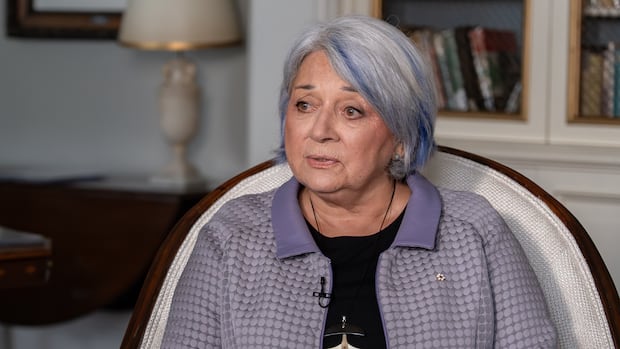
Outgoing Gov. Gen. Mary Simon says the criticisms levelled against her over her ability to speak French were "unfair" and it ultimately did not impede her connecting with Canadians while in the role.
"Of course I think it's unfair, simply because we can't learn a language overnight. I didn't have the opportunity, like others, to take French when I was growing up," Simon said in an interview on Rosemary Barton Live airing Sunday morning.
Simon, who is Canada's first Indigenous Governor General, was known for her work on Arctic and Indigenous issues and for her efforts in advocating for Inuit rights, youth and culture before she took the role.
"When the attack started to happen, it seemed really strange that I would be the one being attacked when a whole committee of people that vetted the process came to the conclusion that I was the right person at the right time for this country," she said.
Simon is bilingual in English and Inuktitut and promised to learn French when she was first appointed in 2021. Shortly after her appointment, the Office of the Commissioner of Official Languages told CBC News it had received 59 complaints.
A lawsuit was later filed by French-language advocacy groups, who argued Simon cannot hold the position because she does not speak French and wanted her appointment invalidated.
WATCH | Simon reflects on backlash to her French skills:In a sit-down interview with CBC News chief political correspondent Rosemary Barton, Governor General Mary Simon reflects on her time at Rideau Hall, including the criticism she faced around her ability to speak French.The federal government attempted to get the lawsuit thrown out, but in 2024 the Quebec Superior Court ruled it could move forward and be heard on its merits.
Simon told host Rosemary Barton she did take it very seriously to learn French.
"I had a tutor. I did two days a week, and I am in a position where I can read French and I can understand what I'm saying in a speech. At the beginning I didn't," Simon said. "The only thing left after all this is said and done is the ability to have a conversation."
The government paid more than $52,000 for 324 hours of French classes as of last year, Simon's office said in response to questions by the Bloc Québécois.
The outgoing Governor General acknowledged Canada has two official languages — English and French — but noted there are many Indigenous languages that are being lost in Canada.
"Even my language, Inuktituk, is slowly weakening because official languages are supported to grow and be prosperous languages whereas Indigenous languages are not. If we're going to save Indigenous languages as a country, we have to do more."
Simon's husband, former CBC journalist Whit Fraser, made headlines in October 2024 after he criticized Quebec media in a Facebook post for their coverage of Simon's French language skills during a trip to the province.
 Mary Simon takes part in the Taking of the Oaths as then-prime minister Justin Trudeau and wife Sophie Gregoire Trudeau look on during the July 2021 installation ceremony for the Governor General of Canada in Ottawa. (Sean Kilpatrick/The Canadian Press)
Fraser wrote that Simon was doing important work in Quebec by highlighting a unique food assistance program, but "overnight, outrage poured from a half dozen additional papers and radio stations, in both 'official languages.'"
"None were asked if they had ever tried learning the Governor-General's Indigenous language, Inuktitut," Fraser wrote.
Journalists who engaged in critical coverage of Simon's language skills didn't acknowledge that she wasn't taught French in Quebec schools, despite being raised in the province, Fraser wrote, adding that "going there is too much hypocrisy to bear."
Simon, a champion of reconciliation, said there's still much more work to do on the issue and that she's been working with an advisory committee to make reconciliation a key part of Rideau Hall's work.
"Hopefully that will continue," Simon said, adding that she's had conversations with incoming governor general Louise Arbour about the work that's been done.
"I think we need to champion to continue leading that priority. And it's about traveling and getting to know both non-Indigenous and Indigenous people across the country and helping to support them," Simon said.
WATCH | Gov. Gen. Mary Simon reflects on truth and reconciliation:Gov. Gen. Mary Simon sits down with CBC’s Power & Politics to reflect on the National Day for Truth and Reconciliation and the upcoming 10-year anniversary of the Truth and Reconciliation Commission's final report.In September last year, nearly a decade after appearing as an honorary witness before the Truth and Reconciliation Commission, Simon said a "tremendous change" is taking place in Canada.
"The most visible is the dialogue that is happening between First Nations, Inuit and Native peoples with other Canadians," she said at the time. Simon also noted reconciliation isn't a policy issue that can be fixed with a set of laws.
Simon told Barton she will continue to carry her role as a bridge builder in the areas she feels passionate about, including reconciliation.
When asked what she'll miss about being governor general, Simon said she'll miss meeting Canadians across the country.
"I love my team, and we work so much together. You get to know people and you find moments where you can spend time together," Simon said. "But the positive side is my family is very happy."
Earlier this month, Carney announced Arbour, a former Supreme Court justice, will be installed as Canada's next governor general on June 8.