








Listen to this article
Estimated 5 minutes
The audio version of this article is generated by AI-based technology. Mispronunciations can occur. We are working with our partners to continually review and improve the results.
Fires and explosions from lithium batteries for e-bikes and e-scooters have led to millions in damage from Nanaimo, B.C., to Moncton, N.B., — and even deaths.
Fire chiefs have voiced concerns and e-bikes face bans in some buildings and transit. Now companies have launched a solution in Canada that they say could have added benefits to the growing numbers of e-bike users seeking an affordable, convenient transportation option.
PopWheels and Powershelter both launched in Canada this spring, offering fireproof charging lockers for e-bike batteries.
Taking a weight off food delivery workersPopWheels is targeting food delivery workers, offering the option to swap batteries so they don't have to carry around extras. Each typically weigh as much as a four-litre jug of milk.
Natnael Kenaw, who delivers food for UberEats and occasionally DoorDash, said he got a lot of back pain when he packed extra batteries in a backpack, so he would try to stash them at the gym and pay convenience stores to charge them so he could get enough power for his whole workday.
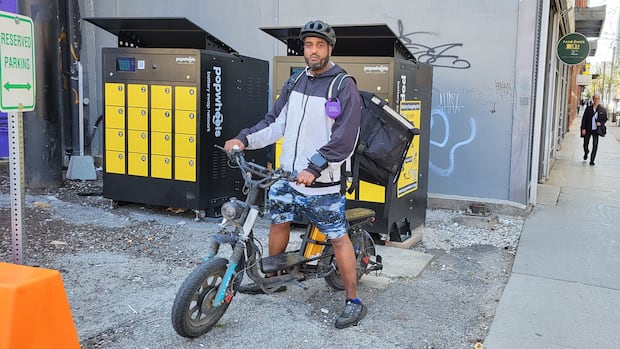
Being able to swap a depleted battery for a fully charged one at Toronto's PopWheels lockers is "like a thousand pounds off your back," said Kenaw, who recently started using the service. "It makes everything so much better, so much easier, convenient. You don't have to worry about anybody stealing your battery."
 After opening an empty PopWheels locker with his phone app, Natnael Kenaw plugs in his depleted battery, and gets a new, full battery from a different locker (Emily Chung/CBC)
PopWheels launched in New York City last year. David Hammer, the company's co-founder and president, said it now has 50 swapping stations there and more than 1,000 customers who have already done 200,000 battery swaps.
In Toronto, it has a single location at Queen and Jarvis – close to the downtown core where Kenaw says food delivery workers can make the most money, although the location isn't ideal because that neighbourhood doesn't always feel safe.
PopWheels charges $75 US a month in New York and $100 a month in Toronto for unlimited swaps. The smart lockers, similar to Amazon pickup lockers, monitor the batteries as they charge and are designed to eject them into a tank of fire suppressant if they detect too much heat.
So far, Hammer said, "we've had zero thermal incidents."
He added that the concept isn't just about safety. "Our customers end up spending less out of pocket than they would if they owned and charged their own batteries," he said, noting that batteries can represent 30 to 40 per cent of the cost of a bike, and theft is an issue.
Why there are so many e-bike battery firesBrett Bouthilier, co-founder of PowerShelter, said there are a few reasons e-bike batteries may seem unusually prone to fires.
Cheaper ones don't come with the same safety features as more expensive ones. The batteries need to be carried around and may be exposed to extreme temperatures or dropped. E-bike users who need more range may also use the wrong charger or try to push extra energy into them, boosting the risk of fires.
That, in turn, can lead to e-bike and battery bans that make it even harder for users to charge and get around.
WATCH | E-bike battery fire engulfs Toronto subway:An e-bike powered by a lithium ion battery aboard a Toronto subway caught fire and quickly spread into the surrounding subway car, injuring one person. As the number of these devices increases, fire chiefs say these types of fires are becoming much more common.Inspired by a banIn fact, it's a ban that motivated Bouthilier, who is originally from Edmonton, to launch PowerShelter in the first place, he explained at a demonstration at the EV and Charging Expo in Toronto last month. While he was working for Tesla in Amsterdam, all employees were given e-bikes to get to work. Then one day, the company banned them from charging at their desks.
"And there were hundreds of us trying to figure out, 'OK, well what are we going to do?"
Bouthilier decided to launch a system of smart, fireproof charging lockers that could be installed by employers, apartments, universities, stadiums, transit stations and other locations as an amenity for e-bike users. The company launched in Amsterdam four years ago, and has since expanded to other European cities.
 PowerShelter co-founder Brett Bouthilier explains the company's e-bike battery charging locker at the EV & Charging Expo in Toronto on April 8. (Oksana Shtohryn/CBC)
It offers battery swapping, similar to PopWheels, in Amsterdam, and is expanding that to Berlin and London.
It also rents lockers by the month or on a single-use basis.
In Toronto, for now, it's hoping owners of condominiums and office buildings will see this as an opportunity to enable more, safer e-bike use.
"When you give somebody an alternative like an e-bike that can go faster than a car [in congested cities], that's cheaper than a car, people value that," he said. He added that research has shown employees who bike to work take fewer days off due to illness. Meanwhile, he said, many people who can't afford a car will rely on an e-bike and charge it indoors, despite the risks, if not given alternatives.
"I think everybody wins when we move charging outside and when we provide proper infrastructure for charging."