









The brutality of centuries of whaling is perhaps best revealed through the banality of how whalers wrote about it.
"This fish is an eight-foot three incher … got about eight tons of blubber off her," reads one logbook entry, dated July 14, 1874.
"Say see yet more soon," it adds.
That entry — and tens of thousands more — is part of new research published in the Proceedings of the National Academy of Sciences that’s helping show the scope of commercial bowhead whale hunting in the 1700s and 1800s.
"I'm sure it took 10 seconds to write from a whaler in a logbook," explains Nicholas Freymueller, an extinction biologist and lead author with Adelaide University in South Australia.
"It really just gives you the gravitas of this extermination, basically."
Estimates put bowhead populations at a minimum of 50,000 before commercial whaling took off in the 18th century, dwindling down to as little as 3,000 in the 1920s.
But these words show more than just the routine business of hunting. From surviving logbooks, the researchers were able to create maps that offer clues about why bowheads survive where they do today.
 A group of bowhead whales comes up for air off the coast of Alaska. (NOAA Fisheries Service/Alaska Fisheries Science Center/National Marine Mammal Lab)Economic backbone
Matthew Ayre, study co-author and Vancouver-based historian, spent a decade poring over those entries, learning the language of a trade that sustained economies.
"There was a point in time where every streetlight in London was lit by whale oil," Ayre told CBC News.
It even gave rise to nightlife across Europe because people didn't go out often in the dark for fear it was too dangerous, he said.
The thirst for whale oil made bowheads a prime target.
"They have a really incredibly thick blubber layer, so lots of oil that can be rendered down from their bodies," said Brenna Frasier, senior curator of zoology with the Nova Scotia Museum in Halifax.
Their baleen — the bendy bristles in their mouths used to sweep up krill — was a valuable resource for things like whalebone corsets.
"It was kind of the world's first plastic."
The importance of these whales to several economies meant hunting expeditions were potentially lucrative, and diligent note-taking was for more than navigation. In Britain, a bounty system was established to encourage ships to set sail.
"But in order to get this bounty, you had to produce your logbook at the customs house," Ayre explained. "That's really what started to ensure the survival of these documents."
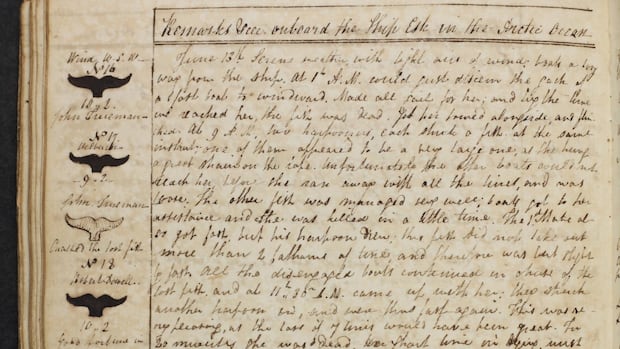
 An 1814 excerpt from a whaling logbook used in the research. Detailed logs were needed in order to get paid for a voyage, experts say. (New Bedford Whaling Museum/Internet Archive)Detailed hunt
 The books contained lots of qualitative information, including how crews reacted to hearing a whale that had been harpooned (known as a fall).
One entry from a logbook, dated May 7, 1814, called it a "curious sight to the men leaving out of their beds when a Fall! A Fall! A Fall! Is called. Some half naked, begin dressing themselves upon deck, others dress themselves in the boats. All in a great hurry."
Alongside colourful language like "flencing" or "flinching" (peeling the blubber) and discarding the "krang" (carcass), these logs had telling details of the kill, too.
The same logbook, on May 30, spoke of a whale being "struck" first at 11 a.m. "At 11:30, the second harpoon was struck. At 1 p.m., she was towed alongside and at 3:20 finished flinching."
"Most log books will contain whale tails when they confirm a kill," Ayre said, "And usually will have the length of the whale or the longest piece of baleen." They also included dates, locations and even latitude and longitude.
Using these details and some computer modelling, Freymueller put together a more complete picture across space and time of these voyages.
"We're able to show, over the decades, the sort of contagion-like spread of whaling as it surged throughout the Arctic," Freymueller said from Adelaide.
 (CBC)Bowheads rebounded in refuges
Despite the intense scale of hunting, there were voyages that weren’t successful. The darker blue areas in the image above are where the intensity of whaling was not as strong. This is likely due to sea ice being too thick for ships to go there in the 18th and 19th centuries. That was the case off the western coast of Greenland and between Alaska and Russia.
Both areas became refuges for bowhead whales, and the research suggests the unsuccessful hunts explain why current populations are seen in greater numbers in these regions.
"It's our hypothesis that those populations were probably not depleted as severely, such that it's easier for them to rebound," Freymueller said.
 Bowhead whales that lived near thicker sea ice are where stronger populations exist today, according to new research. (Amelia Brower/NOAA Fisheries)
Frasier, who was not involved in the study, finds the approach interesting and would like to see it go further.
"I couldn't help but think about the logbooks that exist and the fine-scale information we could get that has to do with other species that were hunted," she said, referring to pilot whales and porpoises.
"When we're thinking of whaling ships going to get, say, bowhead whales, we don't think of the animals they might have taken on the way that were kind of incidental."
Long tail implicationsGlobally, bowhead whales are estimated to now number around 24,000, mostly in those two areas off western Greenland and Alaska. However, two other populations — in the Sea of Okhotsk and the Svalbard-Barents Sea — are considered endangered by the International Union for Conservation of Nature.
Considering bowheads can live for more than 200 years, it’s quite possible, says Freymueller, that there are individual whales that have seen the rise and fall of commercial hunting — and even recovery.
But, he says, it's also a reminder of the impact we can have on species, even when we stop hunting them.
"We often view whaling and say, 'Oh, well, it's this thing that was in the distant past.' Even stuff that happened a century ago is already going to be baked into how the species responds over the next millennium."